Help: SQL Server

Sharing my knowlege about SQL Server Troubleshooting Skills

  • Blog Stats

    • 2,153,602 hits
  • Select GETDATE()

    December 2025
    M T W T F S S
    1234567
    891011121314
    15161718192021
    22232425262728
    293031  

Archive for the ‘A – Z Series’ Category

A-Z of In-Memory OLTP : Garbage Collection (Part 1)

Posted by blakhani on February 7, 2014


We all wants our surroundings to be clean. Sometimes we put efforts to keep it clean and some times we rely on someone else to clean keep it clean. In short, none of us like garbage around us. Garbage is something which has been useful in the past but no more useful. On the same lines, computer world also has term garbage (Wikipedia) and to clean it up, there is a concept called Garbage Collection (Wikipedia). Do you know that in earlier version of SQL there was something similar? Yes, it was “ghost cleanup” back ground process. In SQL Server 2014, garbage collection is “similar” work for data in in-memory tables.

There are two kind of Garbage Collection which exists in In-Memory OLTP:

  • Garbage Collection of Rows in Memory
  • Garbage Collection of Checkpoint Files

Now you might understand why I called this post as part 1. Yes, we would start from the clean-up of rows in memory.

In earlier post, we have discussed about row structure and timestamp. If a row is deleted or updated (which is delete + insert internally) we would have different row versions. It would not be a good idea to delete them physically at the same time. Due to this we would have a number of discarded (garbage) rows in memory. To handle such discarded row versions, garbage collection process is introduced. This process periodically cleans up the rows, which are “garbage” at this point.

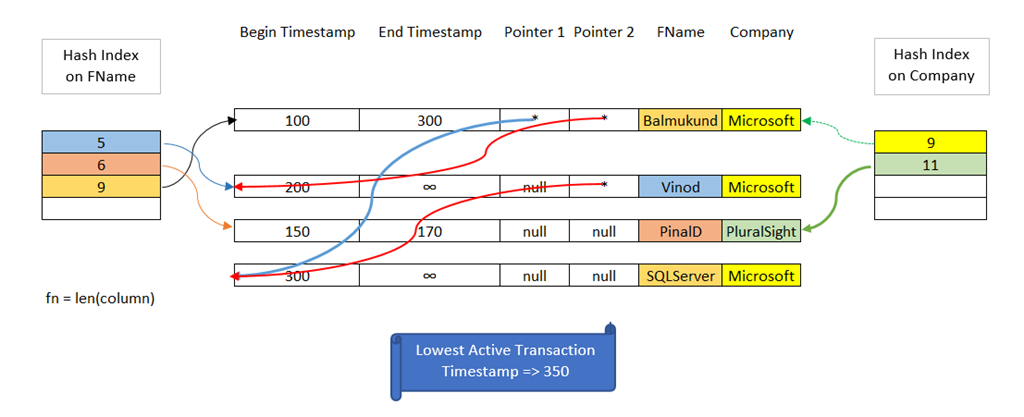
To understand below picture, I would like you to go to hash indexes (part 1 and part 2). I have done color coding to make it easy to read.
image
Image#1 Rows 1 and 4 are garbage at this point.

In above we have end timestamp available for row 1 (Balmukund, Microsoft) and row 3 (PinalD, PluralSight). Notice First and forth row – End Timestamp for Row 1 is Begin Timestamp for Row 4. This would mean that we have fired “Update” and Modified Balmukund to SQLServer at timestamp 300. On the other hand, row 3 was deleted from the system via “Delete” statement at timestamp 170. As indicated in picture, the lowest active transaction time stamp is 350, which means that there is no “active” transaction in the SQL Server whose timestamp is less than 350. Recall that the life of a row is determined by begin and end timestamp. Since all the transactions are above timestamp 350, there is no transaction which would “need” those rows. This would mean that rows 1 and 3 are eligible for the garbage collection. These rows can be removed and their memory can be released back to the system.

The garbage collection system is designed to be non-blocking, cooperative, efficient, responsive and scalable. (taken from Hekaton whitepaper). Let’s me try to explain reason of those words:

  • Non-Blocking: In some systems, when garbage collection activity starts, there is a huge work done and other “real” workload becomes to halt. This is NOT true with SQL Server In-Memory OLTP. It happens in the back ground all the time.
  • Cooperative: In SQL Server In-Memory OLTP, garbage collection is not the responsibility of dedicated system thread alone. All other users threads who are doing reading/writing of data also do a little piece of over all garbage collection work.
  • Efficient: A regular reader thread would do work if it find a row which is stale/garbage.
  • Responsive: Garbage collection process responds to memory pressure. Recall, lazywriter thread in traditional SQL world.
  • Scalable: Work of Garbage collection if shared. Any transaction which is completed would look at the queue and would de-queue the work.

All above points would be clear if you read further.

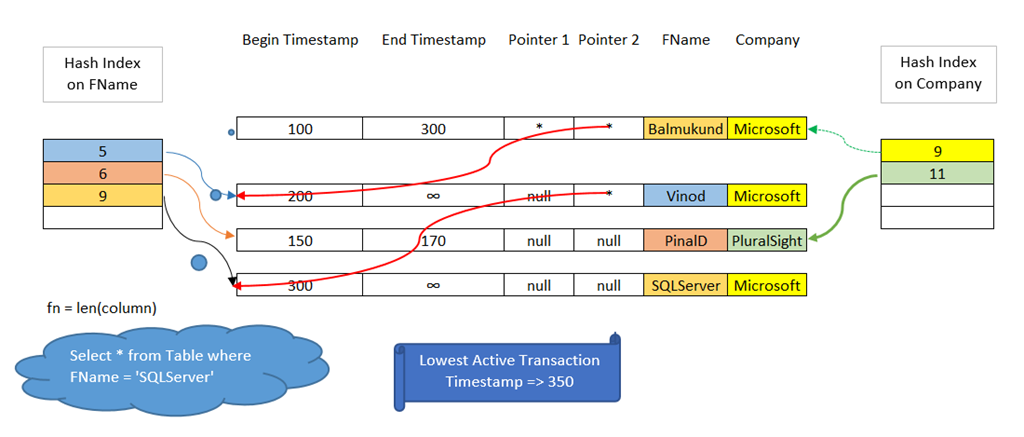
Let’s assume that there is a select statement fired which is using hash Index created on FName column (for example select * from table where FName = ‘SQLServer’). Since hash value of column is 9, it would scan all rows of the bucket. While doing that it would find a row (Balmukund, Microsoft) which is stale (Refer Image#1). The reader thread would delink that row from the chain and move forward. Note that the row is still NOT deleted from memory but a little work of garbage collection has been done. Here is the after image after select query.
image
Image#2 Cooperative work done by User thread doing scan of the bucket.

You might say that what about red chain above (bucket 9)? That would be cleaned by regular garbage collection thread if user thread is not doing it. This means that if we traverse using Index on company and scanning bucket of hash value 9, it would be delinked by user thread else system thread would do it. Below would be the final state of the system once all garbage is cleaned and memory is released.

image
Image#3 Both rows cleaned by garbage collection.

This means that garbage collection is not a discrete process in SQL Server In-Memory OLTP. It can be done by dedicated system thread and also cooperatively done by user threads. This make the garbage collection more efficient.

Hope you have learned something new today! In next blog of the series, we would see the DMVs which can be used to see garbage collection in action.

  • Cheers,
  • Balmukund Lakhani
  • Twitter @blakhani
  • Author: SQL Server 2012 AlwaysOnPaperback, Kindle
  • Posted in A - Z Series, In Memory OLTP, In-Memory OLTP, SQL Server 2014 | Tagged: , , , , , , , , , , , | 1 Comment »

    A-Z of In-Memory OLTP : Native Compilation Advisor in SSMS

    Posted by blakhani on February 4, 2014


    In our last part of A-Z Series, we learned about Memory Optimization Advisor (wizard in SSMS) which can be used to migrate disk based tables to in-memory tables. This post is dedicated to another wizard which is for stored procedure. It is important to remember that, unlike Memory Optimization Advisor, this wizard is NOT to convert regular stored procedures into natively complied stored procedure. The idea of the “Native Compilation Advisor” is to scan the code of stored procedure and give advise about what to change in the stored procedure.

    Where is the wizard?

    The “Native Compilation Advisor” wizard can be launched by right clicking the stored procedure which we wish to convert to natively complied. In below screenshot, we can notice the option difference when we right click on regular stored procedure vs. natively complied stored procedure.

    image

    Image#1 – Comparison of right click.

    What is the purpose?

    As explained earlier, this Advisor would NOT convert regular stored procedure to natively complied but provide just the advice and pointers. Let me explain them via good boy and bad boy. We would use same database which we have been using earlier. Here is the blog to get script for database and tables.

    Good Boy!

    Since we already have database SQLSeverHelp_IMO and tables (DiskBasedTable and MyFirstMemporyOptimizedTable), Let’s create regular stored procedure as below.

    -- Create regular stored procedure in database and referencing IMO table
    Use SQLSeverHelp_IMO 
    GO
    CREATE PROCEDURE [dbo].[InsertName] @iID INT, @vFName VARCHAR(20), @vLName VARCHAR(20)
    AS 
    BEGIN  
    
      INSERT INTO dbo.MyFirstMemporyOptimizedTable
      VALUES (@iID, @vFName, @vLName);
    
    END
    GO

    Now, let’s launch the wizard by right clicking on InsertName stored procedure in SQL Server Management Studio (shown in image 1). As soon as we click on Native Compilation Advisor, we get welcome screen.

    image

    Image#2 – Welcome Screen.

    As we can read on the welcome screen – “The Native Compilation Advisor will assist you to discover and evaluate Transact-SQL elements in your stored procedure that are not supported in Native Compilation”. See, I told you! Okay, Let’s hit next.

    Below screen appears and you would notice that Next button is disabled.

    image

    Image#3 – Stored Procedure Validation – no errors

    This is because there is no T-SQL element which is not supported by Natively complied stored procedures. Cancel the wizard to exit.

    Bad Boy!

    Now, I am going to create stored procedure with some (actually many) elements which are not supported by natively complied stored procedure. Please note that this is for CTP2 and things might change in RTM.

    -- Create regular stored procedure in database   
    -- with many elements not supported by natively complied stored procedures  
    USE sqlseverhelp_imo 
    
    go 
    
    IF Object_id('usp_InsertName_Errors') IS NOT NULL 
      DROP PROCEDURE usp_insertname_errors 
    
    go 
    
    CREATE PROCEDURE [dbo].[Usp_insertname_errors] 
    @iID    INT, 
    @vFName VARCHAR(20), 
    @vLName VARCHAR(20) 
    AS 
      BEGIN 
          -- four part naming   
          SELECT * 
          FROM   hk.sqlseverhelp_imo.dbo.myfirstmemporyoptimizedtable 
    
          -- three part naming 
          SELECT * 
          FROM   sqlseverhelp_imo.dbo.myfirstmemporyoptimizedtable 
    
          -- multivalued insert 
          INSERT INTO dbo.myfirstmemporyoptimizedtable 
          VALUES      (@iID, 
                       @vFName, 
                       @vLName), 
                      (@iID + 1, 
                       @vFName, 
                       @vLName) 
    
          -- Subquery 
          SELECT vfname 
          FROM   diskbasedtable 
          WHERE  iid IN (SELECT is_published 
                         FROM   sys.objects) 
    
          -- goto 
          GOTO hi 
    
          -- cursor 
          DECLARE c CURSOR FOR 
            SELECT iid, 
                   vfname 
            FROM   dbo.diskbasedtable 
    
          HI: 
    
          -- cte 
          WITH cte (i, j) 
               AS (SELECT iid, 
                          vfname 
                   FROM   dbo.diskbasedtable) 
          SELECT * 
          FROM   cte 
      END 
    
    go   
    

    if we run wizard for above stored procedure, we would have next button enabled. This is one of those next button which is not going to make your happy. Agree?

    image

    Image#4 – Stored Procedure Validation – with errors

    Fine, so there are problems. Hitting next would tell us more.

    image

    Image#5 – Final Results!

    As highlighted in image # 5 , we also have the option to “generate report” for these unsupported elements. Here is the report which I saved in html format. It gives us code, line number and they are grouped under T-SQL Element (like *, Four-part names etc.)

    Native Compilation Advisor evaluation results for [SQLSeverHelp_IMO].[usp_InsertName_Errors]

    Report Date/Time:2/3/2014 12:16 PM

    Transact-SQL Element Transact-SQL Code Line Number
    * SELECT * FROM hk.sqlseverhelp_imo.dbo.myfirstmemporyoptimizedtable 3
      SELECT * FROM sqlseverhelp_imo.dbo.myfirstmemporyoptimizedtable 7
      WITH cte (i, j) AS (SELECT iid, vfname FROM dbo.diskbasedtable) SELECT * FROM cte 37
    Four-part names hk.sqlseverhelp_imo.dbo.myfirstmemporyoptimizedtable 4
    Three-part names sqlseverhelp_imo.dbo.myfirstmemporyoptimizedtable 8
    Multi-row table-valued constructor VALUES (@iID, @vFName, @vLName), (@iID + 1, @vFName, @vLName) 12
    One-part names diskbasedtable 21
      cte 42
    IN iid IN (SELECT is_published FROM sys.objects) 22
    Subquery (SELECT is_published FROM sys.objects) 22
    GOTO GOTO hi 26
    Cursors CURSOR FOR SELECT iid, vfname FROM dbo.diskbasedtable 30
    WITH clause WITH cte (i, j) AS (SELECT iid, vfname FROM dbo.diskbasedtable) 37
      cte (i, j) AS (SELECT iid, vfname FROM dbo.diskbasedtable) 37


    Here is the link which is there in image # 5 http://go.microsoft.com/fwlink?LinkID=311587 talks about common patterns and their workarounds. (link might get change after release of the product)

    Conclusion

    Native Compilation wizard can be used to get advice from SQL Server about the changes which are needed to covert a regular stored procedure to natively compiled stored procedure. There are some common pattern of the problems where workaround can be used by following the link provided by the advisor. Conversation of stored procedure is still manual process and not as clean as Table Advisor (Memory Optimization Advisor). Using both wizards, we can get advice to take action prior to a migration. At the end I would say that this is the only wizard I have seen which doesn’t have finish button.

    Have you installed SQL Server 2012 CTP2 yet? If you haven’t yet, be sure to check out the SQL Server 2014 CTP2 so that you can follow this series and get your hands dirty.

    Stay Tuned!

  • Cheers,
  • Balmukund Lakhani
  • Twitter @blakhani
  • Author: SQL Server 2012 AlwaysOnPaperback, Kindle
  • Posted in A - Z Series, Hekaton Series, In Memory OLTP, In-Memory OLTP, SQL Server 2014 | Tagged: , , , , , , , , , , , , , | 2 Comments »

    A-Z of In-Memory OLTP : Memory Optimization Advisor

    Posted by blakhani on January 30, 2014


    While trying something new in real life, it would be great to take advice from someone who is expert in that area. On the same lines, SQL Server Management Studio can help us as “advisor” about migrating disk based tables to In-Memory Tables. Here is an earlier blog about various SSMS enhancements to support In-Memory objects handling.

    Where is the Wizard?

    As always, most of the wizards are in the right click on node of SQL Server Management Studio (SSMS). This option to launch this wizard would come once we right click on a disk based table, as shown below. Note that it won’t be visible if table is already in-memory table.

    image

    Step by Step

    When we select the “Memory Optimization Advisor” below migration wizard will be launched:

    image

    Clicking Next would take us to “Memory Optimization Checklist” screen. This would perform checks for the schema of the table and warn about limitations of in-memory table. My table was a simple DiskBasedTable which we have used in earlier blogs, so all green. Note that my blog posts are on CTP2 and few limitation might be removed in RTM so below checks might change.

    image

    In case of any errors, we would not be able to proceed but advisor would give us hints about where to go. For demo purpose, I have created a table with “problems”

    CREATE TABLE [Address](
        [AddressID] [int] IDENTITY(1,1)  NOT NULL,
        [AddressLine1] [nvarchar](60) NOT NULL,
        [AddressLine2] [nvarchar](60) NULL,
        [City] [nvarchar](30) NOT NULL,
        [StateProvinceID] [int] NOT NULL,
        [PostalCode] [nvarchar](15) NOT NULL,
        [SpatialLocation] [geography] NULL,
        [rowguid] [uniqueidentifier] ROWGUIDCOL  NOT NULL,
        [ModifiedDate] [datetime] NOT NULL,
     CONSTRAINT [PK_Address_AddressID] PRIMARY KEY CLUSTERED 
    (
        [AddressID] ASC
    )WITH (PAD_INDEX = OFF, STATISTICS_NORECOMPUTE = OFF, IGNORE_DUP_KEY = OFF, ALLOW_ROW_LOCKS = ON, ALLOW_PAGE_LOCKS = ON) ON [PRIMARY]
    ) ON [PRIMARY] TEXTIMAGE_ON [PRIMARY]
    
    GO
    
    ALTER TABLE [Address] ADD  CONSTRAINT [DF_Address_rowguid]  DEFAULT (newid()) FOR [rowguid]
    GO
    
    ALTER TABLE [Address] ADD  CONSTRAINT [DF_Address_ModifiedDate]  DEFAULT (getdate()) FOR [ModifiedDate]
    GO


    and if we run wizard for above table, we would get below screen with few red crosses. Try to compare the errors with the definition above.

    image

    Because of these errors we can see that “Next>” button is grayed out. We must resolve these problems before this table can be migrated to an In-Memory OLTP table. We can also use “Generate report” and get HTML file which would have hyperlink about each “show me how”.

    image

    Let’s get back to the original wizard. Pressing next would present “Memory Optimization Warning” screen

    image

    These Information messages allow us to understand the limitation of usage of In-Memory OLTP tables.  To know “More” about each, we can click on the hyperlink that says “More Information”. More Information would open this link. http://go.microsoft.com/fwlink?LinkID=306707 Let’s hit Next now.

    Next screen is about “Review Optimization Options”. In my case, I already have a In-Memory Optimized file-group in the database so they are greyed out. If this a database with no in-memory optimized filegroup then we would get option to create them (Read here). The next option is a checkbox that says “Also copy table data to the new memory optimize table”.  The default value is checkbox unchecked, which means no data will be copied to the new In-Memory OLTP table. Last option is about durability setting of the table which we discussed in previous blog

    image

    Once we hit next, we need to provide details about Primary Key (which is mandatory). We also need to provide details about index type and bucket count, in case of hash index. You can read more about hash indexes (part 1 and part 2)

    image

    Once we provided the options in all previous screens, next screen is “Verify Migration Actions” which is summary of the actions selected in previous screens. 

    image

    if we click on Script button, below is the output in SSMS. If we read carefully, there are based on options selected in wizard. We selected “rename”, “Non Clustered Hash Primary Key” and “Schema and data durability”

    USE [SQLSeverHelp_IMO]
    GO
    
    EXEC dbo.sp_rename @objname = N'[dbo].[DiskBasedTable]', @newname = N'DiskBasedTable_old', @objtype = N'OBJECT'
    GO
    
    USE [SQLSeverHelp_IMO]
    GO
    
    SET ANSI_NULLS ON
    GO
    
    CREATE TABLE [dbo].[DiskBasedTable]
    (
        [iID] [int] NOT NULL,
        [vFName] [varchar](20) COLLATE SQL_Latin1_General_CP1_CI_AS NOT NULL,
        [vLName] [varchar](20) COLLATE SQL_Latin1_General_CP1_CI_AS NOT NULL
    
    CONSTRAINT [DiskBasedTable_primaryKey] PRIMARY KEY NONCLUSTERED HASH 
    (
        [iID]
    )WITH ( BUCKET_COUNT = 16384)
    )WITH ( MEMORY_OPTIMIZED = ON , DURABILITY = SCHEMA_AND_DATA )
    
    GO

    If we click on migrate, the script would be run automatically by the wizard.

    Summary

    As we can see that wizard can be very useful to migrate a disk based table to an In-Memory OLTP table. It can help us in identifying the things you have to do to a table in order to migrate it.  After resolving all the issues we can either generate script to migrate later or use wizard itself to run script.

    Hope you have learned something new today.

  • Cheers,
  • Balmukund Lakhani
  • Twitter @blakhani
  • Author: SQL Server 2012 AlwaysOnPaperback, Kindle
  • Posted in A - Z Series, In Memory OLTP, In-Memory OLTP, SQL Server 2014 | Tagged: , , , , , , , , , , , , , | 3 Comments »