Help: SQL Server

Sharing my knowlege about SQL Server Troubleshooting Skills

  • Blog Stats

    • 2,154,409 hits
  • Select GETDATE()

    January 2026
    M T W T F S S
     1234
    567891011
    12131415161718
    19202122232425
    262728293031  

Posts Tagged ‘A-Z-Series’

A-Z of In-Memory OLTP : Checkpoint – Part 2

Posted by blakhani on December 24, 2013


If you are reading this post before part 1, I would like you to read part 1 so that you have context of what you are reading. In part 1, we have seen demo and usage of DATA files. In this blog I am going to talk about DELTA files.

As we saw earlier each DELTA file is paired with DATA file. I must call out that DATA and DELTA files are not related to a single table but they cover a transaction range (In fact, this was a question asked by one of the reader, Manoj (Blog) in my last post). In in-memory world, when a record is deleted from the table, it’s not removed from the DATA file but a identifier is inserted in DELTA file. This would tell SQL Server that during loading of the data (startup of database), don’t load this particular row in memory as it’s deleted. Now, imagine a situation when we are doing an update to a row.

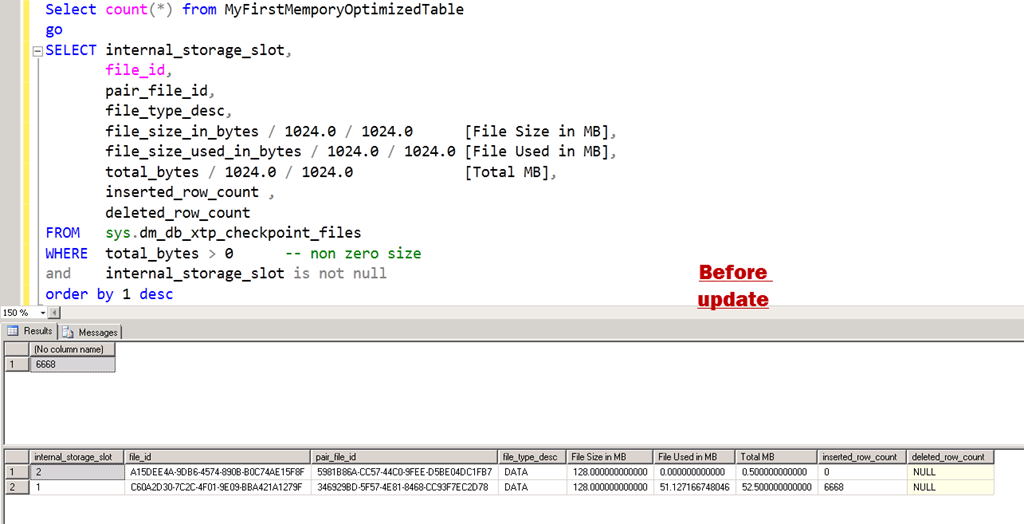
Let’s see this theory in action. I have used same script to populate the data and here is the position where we left in last blog. Here is the query

Select count(*) from MyFirstMemporyOptimizedTable
go
SELECT internal_storage_slot,
       file_id, 
       pair_file_id,    
       file_type_desc,
       file_size_in_bytes / 1024.0 / 1024.0      [File Size in MB], 
       file_size_used_in_bytes / 1024.0 / 1024.0 [File Used in MB], 
       total_bytes / 1024.0 / 1024.0             [Total MB], 
       inserted_row_count ,
       deleted_row_count
FROM   sys.dm_db_xtp_checkpoint_files 
WHERE  total_bytes > 0        -- non zero size
and       internal_storage_slot is not null 
order by 1 desc


image

Now, I am going to delete one third of the rows and make sure to fire a manual checkpoint.

Delete from MyFirstMemporyOptimizedTable
where iID%3 = 0
go
checkpoint
go
----------------------
(3334 row(s) affected)

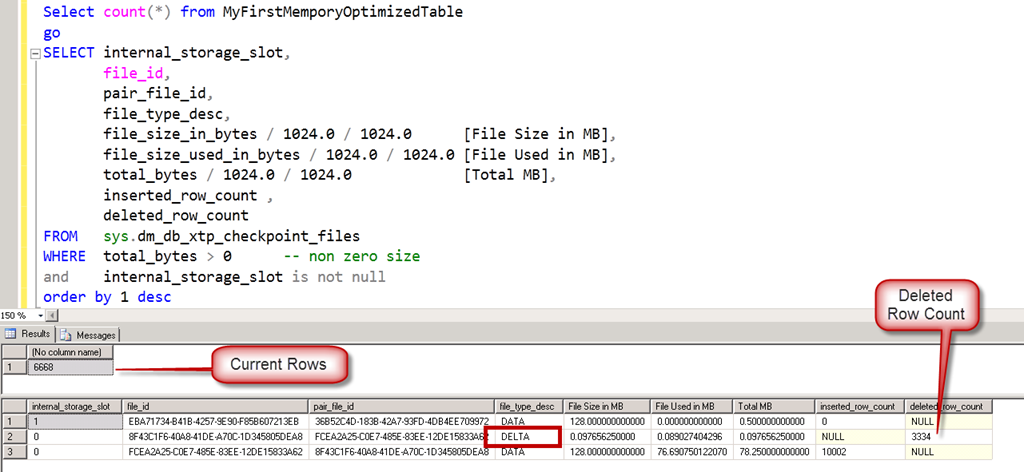
If we run the old query again.
image

Here comes the DELTA files. Note that the internal_slot_id is zero for one pair and one for new DATA file.  After sometime, if we run the exact same query again, we would see a different output.

image

If we look at the file_id, its changed from the previous screenshot. It sounds like a checkpoint has fired by itself and has removed the reference of DELTA file. Current DATA file shows 6668 rows which is exact rows in table. There is no need of DELTA file here.

Now, I am going to fire an update statement and modify all the rows and see the effect.

update MyFirstMemporyOptimizedTable
set vFName = 'www.ExtremeExperts.com'
where vFName = 'ExtremeExperts.com'
go
checkpoint
go


——————

(3334 row(s) affected)

image

image

This matches with the theory that UPDATE is split into DELETE and INSERT. We Updated 3334 rows, which caused append of 3334 rows into DELTA file and append of 3334 rows to DATA file.

In above, “after update” we can see three DATA files and one DELTA file. Let’s fire one more query to understand the transaction range. Here is the query

SELECT internal_storage_slot,
       file_id, 
       pair_file_id,    
       file_type_desc,
       inserted_row_count ,
       deleted_row_count,
       transaction_id_lower_bound,
       transaction_id_upper_bound
FROM   sys.dm_db_xtp_checkpoint_files 
WHERE  total_bytes > 0        -- non zero size
and       internal_storage_slot is not null 
order by 1 desc


image

Each internal_storage_slot is for a range of transaction. Lower bound and upper bound are matching for consecutive slots.

It is important to recall that writing (appending to be precise) to DELTA and DATA file is NOT done by any user transaction but background checkpoint thread. In our tests we are firing manual checkpoint to see the immediate effect to learn which would not be the case in production server. The background thread, scans the log buffers (and if needed, transaction log file) to append to those files. As per Hekaton Whitepaper by Kalen, below are the steps done by checkpoint.

1. All buffered writes are flushed to the data and delta files.

2. A checkpoint inventory is constructed that includes descriptors for all files from the previous checkpoint plus any files added by the current checkpoint. The inventory is hardened to the transaction log.

3. The location of the inventory is stored in the transaction log so that it is available at recovery time.

Till, I wrote last few lines, another system process happened and here is the final output.

image

We would discuss about merge process in later part of the series.

Hope you have already downloaded SQL Server 2014 CTP2 and learning In-Memory OLTP (a.k.a. Hekaton) with me. If you haven’t yet, be sure to check out the SQL Server 2014 CTP2 so that you can follow this series and get your hands dirty.

  • Cheers,
  • Balmukund Lakhani
  • Twitter @blakhani
  • Author: SQL Server 2012 AlwaysOnPaperback, Kindle
  • Posted in A - Z Series, Hekaton Series, In Memory OLTP, In-Memory OLTP, SQL Server 2014 | Tagged: , , , , , , , , | 3 Comments »

    A-Z of In-Memory OLTP : Checkpoint – Part 1

    Posted by blakhani on December 19, 2013


    In today’s advance world, RAM is still volatile. Once you pull the power plug out, all the content of RAM is flushed. Since we are talking about in-memory tables, what would happen to data in tables? If we have defined a table as durable (SCHEMA_AND_DATA) in SQL Server, durability has to be maintained. During recovery of the database (also known as crash recovery), all the content should come back. To achieve this, SQL Server does logging into transaction log and writes checkpoint for in-memory tables.

    If you are a SQL Server DBA and worked with earlier versions of SQL, checkpoint is definitely known to you. You can read more about earlier version of checkpoint in books online. In short, checkpoint is a process which writes dirty pages from memory to data file. This is done to reduce the recovery time of the database during crash recovery. Checkpoint can be done by system thread based on recovery interval or triggered on demand when system is low on memory, or other operations such as log backup etc.

    “Similar” concept of checkpoint exists for In-Memory tables as well. I quoted similar because mechanism is different than the known checkpoint process for disk-based tables. To maintain durability of data for in-memory tables, SQL Server does logging of changes in transaction log (which is also different than disk based tables) and writes information during checkpoint. In this blog, we would try to understand the various things which happens during checkpoint. We should remember that transaction logging is sufficient to recover the data but if there is no checkpoint then we need to read complete transaction log during crash recovery, which would be inefficient. So, periodically checkpoint is fired and data is dumped into checkpoint files. Now, during recovery, we recover from checkpoint and replay only that portion of transaction log which is after checkpoint.

    Checkpoint files are created into filegroup MEMORY_OPTIMIZED_DATA which is container for these files. During checkpoint, we try to use log buffer in memory to write information into checkpoint files. There are chances that log buffer is not having sufficient log blocks and then we would end-up in reading transaction log file. SQL Server uses FILESTREAM as underlying storage mechanism for checkpoint files. The checkpoint information is written into the disk by checkpoint streams, which comes in two flavors:

    • DATA streams:
      • These file are approximately 128 MB in size.
      • They contain only inserted rows of the table in the given timestamp range.
    • DELTA streams:
      • These are paired (1:1) with DATA files.
      • Size of these file is not constant.
      • Store the deleted rows with IDs.

    Note that both files are “append only” files which means the IO would always be sequential. As soon as table is created, DATA files are pre-allocated with 128 MB size. DATA and DELTA files form a pair for a timestamp range. Once current DATA file becomes full, SQL Server would switch to new DATA file.

    Enough of theory? Let’s see a checkpoint in action.

    For demo purpose, I am creating table in the database which is having wide row. Here is the complete script.

    -- Create database having container C:\IMO_Database\SQLSeverHelp_IMO_dir
    CREATE DATABASE SQLSeverHelp_IMO 
        ON PRIMARY (
        NAME = [SQLSeverHelp_IMO_data]
        ,FILENAME = 'C:\IMO_Database\SQLSeverHelp_IMO.mdf'
        )
        
        ,FILEGROUP [SQLSeverHelp_IMO_FG] CONTAINS MEMORY_OPTIMIZED_DATA ( 
        NAME = [SQLSeverHelp_IMO_dir]
        ,FILENAME = 'C:\IMO_Database\SQLSeverHelp_IMO_dir'
        ) 
        
        LOG ON (
        NAME = [SQLSeverHelp_IMO_log]
        ,Filename = 'C:\IMO_Database\SQLSeverHelp_IMO_log.ldf'
        ) 
    GO
    
    
    -- Create In-Memory table
    Use SQLSeverHelp_IMO
    GO
    CREATE TABLE MyFirstMemporyOptimizedTable
    (
    iID INT NOT NULL PRIMARY KEY NONCLUSTERED HASH WITH (BUCKET_COUNT = 100000),
    vFName CHAR(4000) NOT NULL,
    vLName CHAR(4000) NOT NULL
    ) WITH (MEMORY_OPTIMIZED = ON, DURABILITY = SCHEMA_AND_DATA)
    GO

    As soon as table is created, we would see DATA and DELTA file in the container. We can use DMV sys.dm_db_xtp_checkpoint_files to see the information. Let’s first run a very basic query to understand the files.

    SELECT file_id, 
           pair_file_id, 
           file_type_desc, 
           is_active 
    FROM   sys.dm_db_xtp_checkpoint_files 
    ORDER  BY is_active DESC;   


    Here is the output with some highlights. I have put the same color for the matching file_id with pair_file_id column for clarity.

    image

    As we can see in output, DATA and DELTA files are having pair. I have highlighted only two pairs but if you look carefully, all files are paired. Note that the number of files created is a function of number of CPU cores on the system. My machine has 8 logical CPU so I am seeing 9 pairs. Is_Active column represents whether the files is currently in use or not. Another way to find out paired files is to use column called internal_storage_slot. Only those files which are having not null slot would be used by checkpoint.

    SELECT internal_storage_slot,
           file_id, 
           pair_file_id,    
           file_type_desc
    FROM   sys.dm_db_xtp_checkpoint_files 
    WHERE  internal_storage_slot is NOT NULL

    Here is the output. Two files having same slot form a pair of DATA-DELTA (slot 3 in below screenshot).

    image

    Here is how the physical files on operating system look like:

    image

    Now, you may ask – how would I associate the file in the OS with the file_id and pair_file_Id column in sys.dm_db_xtp_checkpoint_files? Let’s use other columns of DMV to explore that information.

    image

    I have tried to make the picture self-explanatory. Highlight with the same color are the matching texts.

    Now, lets try and check what happens when we insert some rows in the table. As we discussed earlier, DATA file would contain the rows which are inserted and DELTA file would have entries of deleted rows. I have used below script to load ~10K rows into the table.

    DECLARE @counter INT 
    SET @counter = 0 
    WHILE @counter <= 10000 
      BEGIN 
          INSERT INTO myfirstmemporyoptimizedtable 
          VALUES      (@counter, 
                       'SQLServer-Help.com', 
                       'Balmukund Lakhani'), 
                      (@counter + 1, 
                       'ExtremeExperts.com', 
                       'Vinod Kumar M'), 
                      (@counter + 2, 
                       'SQLAuthority.com', 
                       'Pinal Dave') 
    
          SET @counter = @counter + 3 
      END

    Now, Let’s go ahead and query the DMV again to see if we have something interesting! But Wait! We don’t know if checkpoint has automatically fired or not. So before running the query, I fired manual checkpoint via “CHECKPOINT” command in management studio.

    SELECT internal_storage_slot,
           file_id, 
           pair_file_id,    
           file_type_desc,
           file_size_in_bytes / 1024.0 / 1024.0      [File Size in MB], 
           file_size_used_in_bytes / 1024.0 / 1024.0 [File Used in MB], 
           total_bytes / 1024.0 / 1024.0             [Total MB], 
           inserted_row_count 
     FROM   sys.dm_db_xtp_checkpoint_files 
     WHERE  total_bytes > 0        -- non zero size
     and       internal_storage_slot is not null 

    As we can see that at this point only one DATA file is having non-zero size and number of rows shown are 10002, which were inserted earlier.

    image

    As we insert more and more rows, data would be accumulated in DATA file and once its full, next file would be opened used and current file becomes read-only. Please remember that 128 MB is NOT the limit of the checkpoint DATA file. A transaction can’t span across two DATA files, so a bigger transaction could cause a file to go beyond 128 MB size. For demo purposes, instead of 10K rows, I have inserted ~40K rows in one transaction.

    image 

    If you are wondering why we are not seeing any DELTA file in any of the query output then recall that DELTA file would contain the DELETEed rows identifier and so far I have been doing only INSERTs. To give you some time to grasp information in this blog, I would stop here and we would discuss other aspects of checkpoint in next blog for this A-Z series.

    In case you have any question, post them in comment section and I would be happy to answer them.

  • Cheers,
  • Balmukund Lakhani
  • Twitter @blakhani
  • Author: SQL Server 2012 AlwaysOnPaperback, Kindle
  • Posted in Hekaton Series, In Memory OLTP, In-Memory OLTP, SQL Server 2014 | Tagged: , , , , , , , , | 11 Comments »

    A-Z of In-Memory OLTP : Native Compilation

    Posted by blakhani on December 17, 2013


    Imagine that you are participating in a 400 meters running competition and you are the only one to get discount of 300 meters and allowed to start 100 meters before the finish line. What would be the result? All participants have to run 400 meters and you would run only 100 meters. Of course, You would win!!! (terms and condition apply). In the same way, what would happen in SQL world, if we finish a significant amount of work i.e. compilation of stored procedure during creation phase. Yes, you are correct. The time spent in execution of the stored procedure would be less. In this post we would try to learn internals of native compilation.

    In earlier “T-SQL Constructs” post of this series, we have seen syntax of creation of natively compiled stored procedure. Native compilation of the stored procedure causes machine language code (i.e. DLL) to be generated and loaded in SQL Server Memory. Natively compiled stored procedures allows us to execute T-SQL in the fastest way, which includes accessing data in memory-optimized tables. In addition, disk-based tables are not allowed to be accessed at all inside natively compiled stored procedures. If we attempt to create a natively compiled procedure which accesses disk based table, we would get below error. In my test, the table name was DiskBasedTable.

    Msg 10775, Level 16, State 1, Procedure InsertName, Line 14
    Object ‘dbo.DiskBasedTable’ is not a memory optimized table and cannot be accessed from a natively compiled stored procedure.

    The advantages of natively complies stored procedure is that most of the work (permission check, object existence check, query plan generation) is done during compilation/creation of stored procedure. Due to this there are many limitations on the Transact-SQL that is allowed, the data types and collations that can be accessed and processed in natively compiled procedures. SQL Server Product Documentation team has done good amount of work in documenting them (refer Supported Data Types, Unsupported Transact-SQL Constructs)

    To get a list of natively complied stored procedures we can use catalog views as shown below. Highlighted below is the new column added to support in-memory OLTP.

    SELECT uses_native_compilation, 
           object_id, 
           Object_name(object_id) 
    FROM   sys.sql_modules 
    WHERE  uses_native_compilation = 1 
    go 
    
    SELECT uses_native_compilation, 
           object_id, 
           Object_name(object_id) 
    FROM   sys.all_sql_modules 
    WHERE  uses_native_compilation = 1 
    go


    Here is the output in SSMS

    image

    To convert a stored procedure to DLL, SQL Server engine uses C compiler. Does this mean we need to have C installed on the machine when we install in-memory OLTP? Well, we just need to complie the C code so we just need compiler related files. SQL Server product comes with compiler files. As soon as SQL Engine is installed, these files are installed under <SQL Server Installation Directory>\MSSQL\Binn\Xtp folder. Main compilation files are located under ..\VC\bin folder.

    image

    Sometimes, we might face stored procedure creation failure due to issues in compilation of the C code. To make our life easier, SQL Server generates intermediate files and they are useful for troubleshooting by members of product support team. Here is the text of .out file.

    Microsoft (R) C/C++ Optimizing Compiler Version 17.00.60605.1 for x64

    Copyright (C) Microsoft Corporation.  All rights reserved.

    xtp_p_8_581577110.c

    Microsoft (R) Incremental Linker Version 11.00.60605.1

    Copyright (C) Microsoft Corporation.  All rights reserved.

    /out:xtp_p_8_581577110.dll

    /ltcg

    /debug

    /dll

    /implib:xtp_p_8_581577110.lib

    "/LIBPATH:C:\Program Files\Microsoft SQL Server\MSSQL12.MSSQLSERVER\MSSQL\Binn\Xtp\gen\lib"

    "/LIBPATH:C:\Program Files\Microsoft SQL Server\MSSQL12.MSSQLSERVER\MSSQL\Binn\Xtp\VC\lib"

    /noentry

    /nodefaultlib

    /incremental:no

    /ltcg

    /wx

    /FUNCTIONPADMIN

    xtp_p_8_581577110.obj

    hkgenlib.lib

    hkruntime.lib

    hkengine.lib

    hkgenexp.exp

    hkcrt.lib

    hkk32.lib

    hkversion.obj

    Generating code

    Finished generating code

    If you are a C developer, it may be easy for you to understand the switches passed during calling of CL.exe. There is no real need for a DBA to know all these options. In case you are too excited, read here for the parameters.

    Before I conclude, I would like you to throw ideas about below error, while creation of natively compiled stored procedure.

    image

    Here is the text of the message:

    Msg 41312, Level 16, State 4, Procedure InsertName1, Line 2

    Unable to call into the C compiler. GetLastError = 2.

    Of course, I broke something and above is the error I am getting. Can you guess? Go ahead and comment on the post.

    Stay Tuned for next part of the series.

    Cheers,

    Balmukund Lakhani

    Twitter @blakhani

    Author: SQL Server 2012 AlwaysOnPaperback, Kindle

    Posted in A - Z Series, Hekaton Series, In Memory OLTP, In-Memory OLTP | Tagged: , , , , , , | 1 Comment »